

In Hue, under a clear sky, I stood before an old light blue car, parked in a corner of the Từ Đàm temple. It wasn’t abandoned but preserved like a treasure, protected from sun and rain, as a precious object. The license plate, DBA 599, probably references a South Vietnamese regime vehicle used before 1975. Next to it, a sign explains in Vietnamese and English:

“A relic. With this car, Thích Quảng Đức traveled from the Ấn Quang pagoda to the intersection of Phan Đình Phùng and Lê Văn Duyệt streets on June 11, 1963, in Saigon. Upon exiting the car, he sat in the lotus position and set himself on fire, dying to protest against Ngô Đình Diệm’s discriminatory policies.”

No further comment. Only those words were enough to awaken in me the curiosity and the need to understand who Thích Quảng Đức really was and what that journey from a Saigon pagoda to the place of a final appointment with life, on that blue car that moved without hesitation toward a fire destined to ignite the conscience of the world. I noticed it because it had nothing to do with the rest: no other vehicle, no sign of modernity. Only that old “Austin,” frozen in time.

The car did not belong to Thích Quảng Đức: it had been lent to him by a lay Buddhist for that dramatic move, and after 1963, it was taken to Huế, a city symbol of religious repression, and kept as a relic. An elderly monk, seeing me fixate on the car, approached silently. With a faint voice, in rough English, he told me:
“This car was used that day. It did not leave from here, but from Saigon. It was with this that Thích Quảng Đức arrived at the intersection… and sat in the fire.”
He said no more. There was no need. At that moment, I understood that I was not just observing an antique vehicle. I was looking at the means that had carried a man from a temple to a crossroads, and from there to eternity.
And I decided to retrace that journey.
The intersection of history
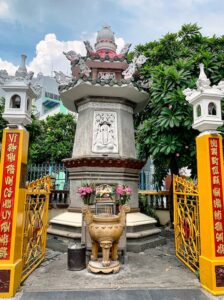
 In Ho Chi Minh City, the intersection of Nguyễn Đình Chiểu and Cách Mạng Tháng Tám (formerly Phan Đình Phùng and Lê Văn Duyệt) is busy, noisy, full of motorbikes and cars. On the southeast corner of the intersection between Nguyễn Đình Chiểu and Cách Mạng Tháng Tám, there is today a stone monument dedicated to Thích Quảng Đức. It is not a temple, nor a monumental building, but a simple and well-maintained structure. On the façade, a white bas-relief depicts him in a meditative, serene pose, surrounded by lush leaves. In front, a richly decorated incense burner. The monument is enclosed between two yellow and red gates, with traditional Asian motifs, like those of temples, topped by two white lanterns. In front, fresh flowers, lit incense sticks, fruit offerings.
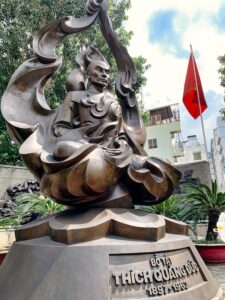
Across the street, along the sidewalk, there is a second monument, apparently made of bronze, more minimal. In the center, a figure depicts the monk engulfed in flames, seated in a lotus position, motionless. At the base, a clear engraved inscription in Vietnamese characters:
 bồ tát
Thích Quảng Đức
1897 – 1963
Bồ tát is a Vietnamese word meaning “bodhisattva,” that is, “one who, having reached Nirvana, enlightenment, chooses to reincarnate again in the world not for himself, but out of compassion, to help others find the way.”
Within that title, that name, and those dates lies everything: a life, a gesture, a truth that no regime has managed to extinguish. Behind the monument, there is a bas-relief that recalls the monk’s path toward sacrifice. I walked slowly along the monument. Then I sat on a nearby bench. The silence seemed almost to cover the sounds. A man was lighting incense. A woman left a bunch of white flowers at the feet of the Buddha statue. Traffic flowed, but at that point, time seemed to bend.
The Photographer Who Didn’t Want to Take the Shot
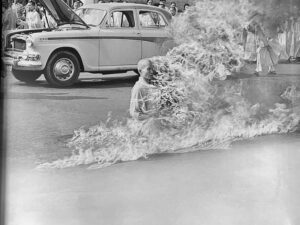
There was a witness. A man with a camera. Malcolm Browne, a photographer for the Associated Press, who received an anonymous phone call the night before:
“Tomorrow, at noon, a monk will set himself on fire in protest.”
He arrived at the scene with a colleague, and when the flames engulfed Thích Quảng Đức, Browne took eleven photographs. The first image was published worldwide. He won the Pulitzer Prize in 1964, but throughout his life, Browne said:
“It’s the photo I wish I never took. But if I hadn’t taken it, no one would have believed it.”
The photograph shows not only a body in flames. It shows the now-famous Austin car stopped in the middle of the street with its hood open and a crowd of monks watching in silence and astonishment. It captures the weight of silence. And most importantly, it shows that sometimes, the truth needs a witness.
The Heart That Did Not Melt
 I then went to the Xá Lợi temple, in the heart of Ho Chi Minh City, where a relic is kept. According to tradition, after cremation, an intact round object was found among the ashes: what many recognized as the monk’s heart. In Vietnamese Buddhism, a heart that withstands fire is a symbol of từ tâm bất diệt — the immortal heart of compassion that does not die. Today, the heart is kept in an inner room of the Xá Lợi temple, accessible to anyone who wishes to see it.
“The heart of Thích Quảng Đức… can I see it?”
A monk looked at me for a long moment, then gently shook his head.
“Not today. It is kept here, but it is not displayed every day. It is a sacred object.”
I didn’t insist. It wasn’t the right moment. But I understood. It’s an inner sign, more than an object to be shown. But the fact that it exists, that it is protected, that people speak of it softly… says everything.
What did that gesture truly mean?

Thích Quảng Đức was not a revolutionary. He did not want destruction. He wanted awakening. His act was neither suicide nor an act of hatred. It was a bài hương cúng dường — a fire offering — rarely practiced in Mahāyāna Buddhism, inspired by the Bodhisattva who sacrifices the body for the benefit of others.
He did it not to attract attention, but because attention had been denied. For months, Buddhists had been humiliated: flags banned, temples closed, arbitrary arrests. Ngô Đình Diệm’s government, Catholic, ruled a majority Buddhist nation as if it were a diocese. A letter he wrote before fulfilling his destiny ends with these words:
“Before closing my eyes and moving towards the vision of the Buddha, I respectfully implore the president to have a compassionate mind towards the people and to guarantee religious equality, for the eternal good of the homeland.”
The Journey Continues
Today, Diệm’s regime is history. Vietnam is a different country. But the monument in Saigon, the car in Huế, the urn kept in the Xá Lợi temple are important signs that suggest memory does not extinguish with fire. And as I was leaving Chùa Quán Thế Âm, with traffic resuming its rhythm, I thought of one thing: Sometimes, to make a voice heard, you have to become silence.
Practical Information for Visitors
- Từ Đàm Temple (Hue):
Address: 29 Phan Đình Phùng, Hue
Hours: 5:00–18:00
Thích Quảng Đức’s car: visible in the courtyard (not always accessible)
Dress code: cover shoulders and knees - Quán Thế Âm Pagoda (Ho Chi Minh City):
Address: Corner of Nguyễn Đình Chiểu and Cách Mạng Tháng Tám
Monument: open 24/7
Dress code: respectful; remove shoes inside - Xá Lợi Temple (Ho Chi Minh City):
Address: 89 Bà Huyện Thanh Quy, District 3
The heart of Thích Quảng Đức: kept in a sacred room, not regularly on display
Photos by Guglielmo Zanchi (Pluto)


