
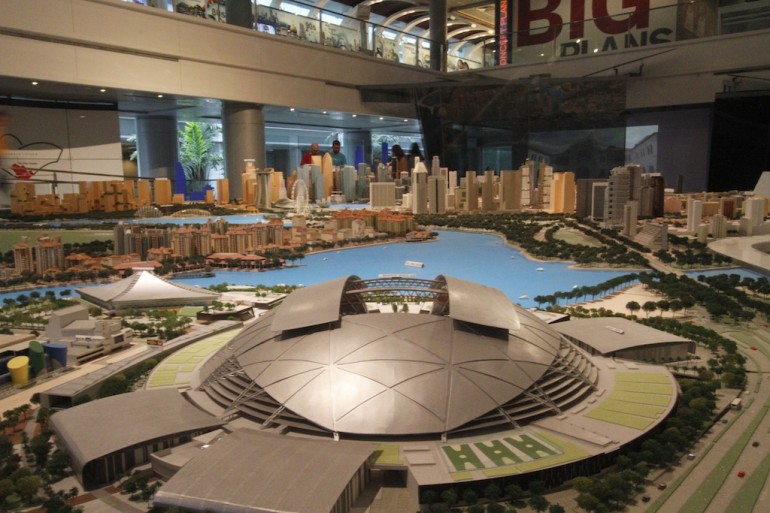

URA gallery
My visit to the Singapore City Gallery was entirely unplanned. A sudden downpour at 4pm cut short my afternoon wandering through Chinatown, and with rain showing no intention of stopping, I ducked into the nearest shelter. That shelter turned out to be one of the most enriching places I visited during my entire time in Singapore.
A City’s Story, Told in Three Floors
Opened in 1999 and housed inside the Urban Redevelopment Authority (URA) Centre on Maxwell Road, the Singapore City Gallery is a quietly extraordinary place. It tells the story of one of the world’s most remarkable urban transformations — how a small, resource-poor island became a thriving first-world metropolis of six million people in the space of just half a century.

Singapore from present to future
Spread across three floors, the gallery covers more than ten thematic areas through audiovisual presentations, interactive exhibits, and architectural scale models that range from the beautifully detailed to the genuinely jaw-dropping.
The Central Area Model

The amazing island wide model
The centrepiece of the gallery — and one of its oldest exhibits — is the Central Area Model on the first floor. This is one of the largest architectural scale models in the world, and it earns that title. Every building in Singapore’s city centre is rendered with painstaking accuracy, including structures currently under construction and those still in the planning pipeline, such as the vast Marina South development. Once an hour, the model comes alive with a three-minute light and sound show that traces the city’s transformation from above. Standing over it, you get a genuine bird’s-eye view of an entire metropolis — something that never quite loses its sense of wonder no matter how long you linger. Click here for an online virtual tour to explore the Central Area Model up-close: http://www.ura.gov.sg/uol/citygallery/About/architectural-models/central-area-model.aspx
More Than Just Models

Central area model
Beyond the scale models, the gallery offers a rich variety of interactive and experiential exhibits. A panoramic show depicts the rhythms of daily life on the island. Other sections cover Singapore’s ambitious land reclamation programme, its conservation efforts, the careful preservation of heritage neighbourhoods, and the ongoing challenge of planning a dense, liveable city for the future. The information is presented with real creativity — this is not a dry archive. It is a genuinely engaging space that rewards curiosity at every turn.
Practical Information
The gallery is free to enter, fully air-conditioned — a blessing in Singapore’s humidity — and there is a restaurant and café on the ground floor for when you need a break. Over 200,000 people visit each year, and it is easy to understand why. Whether you have a passion for architecture and urban design or simply a couple of spare hours, this is time exceptionally well spent.

Entrance of URA
Singapore City Gallery Free Admission Opening Hours: Monday to Saturday, 9.00am – 5.00pm Closed on Sundays and Public Holidays
Address: 45 Maxwell Road, The URA Centre, Singapore 069118 Tel: +65 6321 8321 Email: ura_gallery@ura.gov.sg Website: www.ura.gov.sg/citygallery
Getting There: MRT — Tanjong Pagar (EW15) or Chinatown (NE4/DT19) Bus — stops A, B, and C served by multiple routes including 61, 80, 131, 166, 167, and 970 Bicycle — 10 parking lots available at the URA Centre
Located very close to Maxwell Food Centre and a short walk from Chinatown.


