
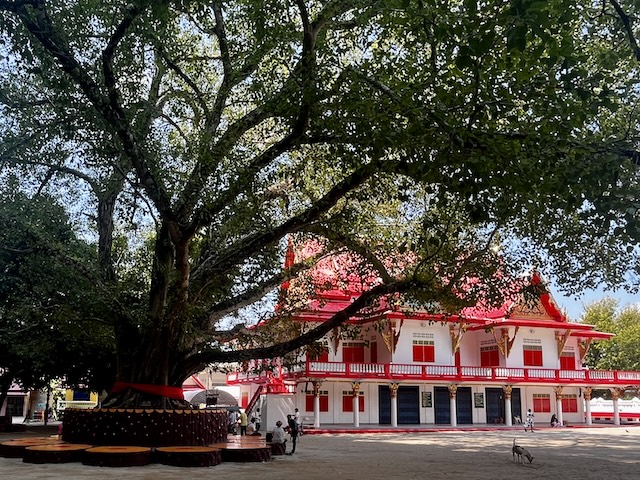
This is the second chapter of our media trip through Phang Nga province. In our first day, we explored the coast and jungle west of Phang Nga — waterfalls, a teakwood temple by the sea, and empty Andaman beaches. Today, we drove further east, into the heart of the province: Phang Nga town itself.
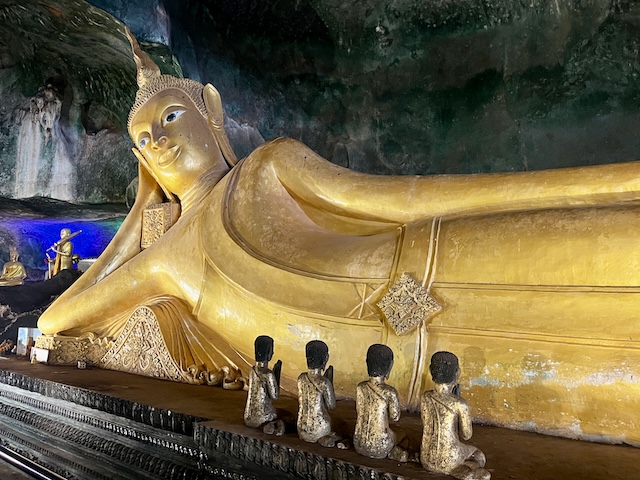
15-metre-long reclining golden Buddha at Wat Tham
Baan Ati Resort & Spa, our base in the Natai area, made the perfect launchpad again. The wooden stilt villas, the canal, the mountain air — after a good night’s sleep surrounded by all of that, heading deeper into Phang Nga felt less like an obligation and more like a continuation of something that had already begun to feel very right.
The Golden Buddha in the Rock: Wat Suwan Kuha
Our first stop was not in the town itself but on the road leading to it — and it proved an unmissable beginning. Wat Suwan Kuha, known locally as Wat Tham or the Monkey Temple, is a Buddhist temple built directly inside a vast limestone cave about ten kilometres before Phang Nga town. The largest chamber, Tham Yai, houses the temple’s most celebrated attraction: an impressive 15-metre-long reclining golden Buddha, surrounded by smaller sitting and standing Buddha statues that fill the cave with a calm, devotional atmosphere.
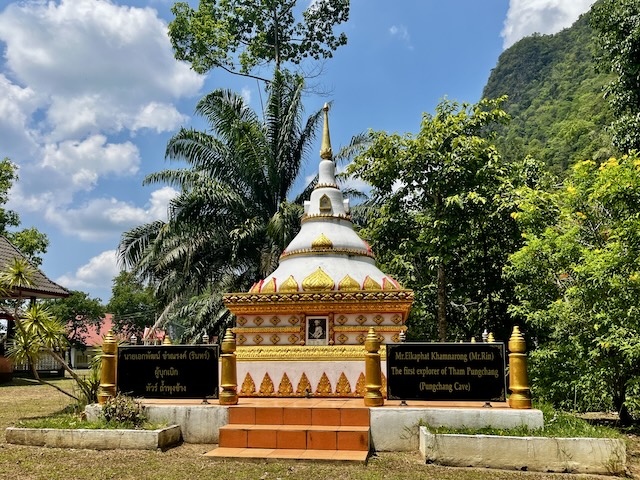
The large chedi which contains the bones of the Na Takuathung family
The setting is unlike any conventional temple you will encounter in southern Thailand. The cave ceiling soars overhead, stalactites hang in silence, and the light that filters through the entrance gives everything inside a particular, otherworldly quality. There are a number of other Buddha images throughout, as well as a large chedi which contains the bones of the Na Takuathung family — the local governors of some 160 years ago, who arranged for the construction of the original shrine inside the cave. History and faith are literally embedded in the rock here.
Outside, the resident troupe of monkeys adds a note of cheerful chaos to an otherwise deeply peaceful place. At the cave entrance, a stupa structure echoes the famous Wat Arun in Bangkok, and stairs beside the reclining Buddha lead up to a smaller cave with another golden stupa. Allow yourself more time than you think you need. Wat Suwan Kuha has a way of holding you.
Inside the Elephant: Tham Phung Chang

Phang Nga town temples caves travel guide
From almost any point in Phang Nga town, you can see it — a great limestone mountain crouching on the horizon, shaped unmistakably like an elephant at rest. The locals have always known it as Khao Chang, Elephant Mountain, and it is no coincidence that the elephant appears on the provincial seal.
The mountain is home to one of Phang Nga’s most significant temple compounds: Wat Prapaht Pracimakhet, known to everyone simply as Wat Tham Phung Chang. Before you think about the cave, the temple grounds themselves deserve time and attention. Shaded by ancient trees, the compound carries the quiet authority of a place that has long been central to the spiritual life of this town. At the cave entrance stands the Sala Pho Ta Khao Chang — a sacred spirit shrine dedicated to the guardian of Elephant Mountain — and guides traditionally lead visitors to pay their respects here before entering.
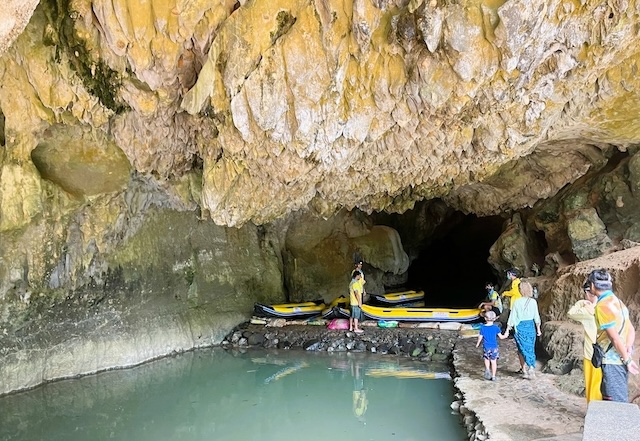
canoe through the deeper flooded sections of the cave
The cave itself — Tham Phung Chang, meaning “Elephant Belly Cave,” listed by the Tourism Authority of Thailand among the Unseen Thailand destinations — opens from the back of the temple compound. It runs for approximately 1,200 metres through the heart of the mountain, with two entrances, one on the west side and one on the east. The tour combines three modes of exploration: canoe through the deeper flooded sections, bamboo raft where the ceiling drops lower, and finally on foot through shallower water. Headlamps are provided.
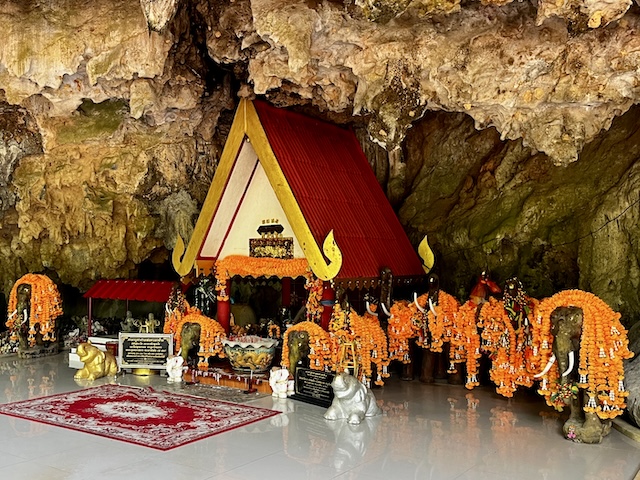
Sala Pho Ta Khao Chang — a sacred spirit shrine dedicated to the guardian of Elephant Mountain
Inside, formations emerge that the guides bring to life: a stone shape resembling a crocodile, a sacred pool whose still water mirrors the shape of an elephant’s head, figures that suggest dinosaurs and giant turtles. When torchlight catches the tips of the stalactites, the calcite crystals catch the beam and sparkle like scattered diamonds. Bats cling to the ceiling in large numbers throughout, including bumblebee bats — the world’s smallest.
Photography is not permitted inside, which forces you to simply be present. That, as it turns out, is the right way to experience it. The whole tour takes about an hour and a half, and it is time exceptionally well spent. Open daily from 08.30 – 16.00 hrs. Entrance fee : 500 baht/person and a tour of the cave takes around 1.5 hours
Lunch with History: Khun Thip’s Satay
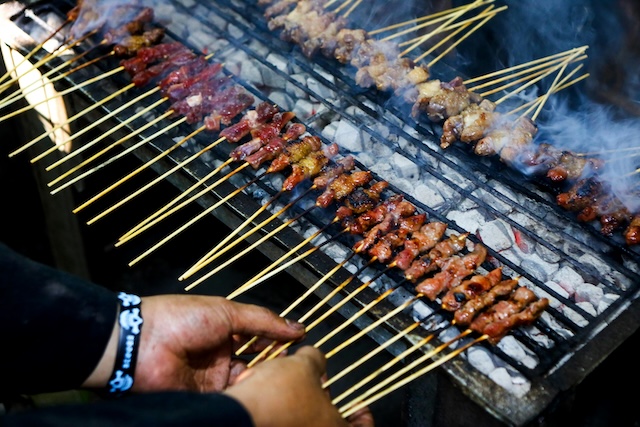
Khun Thip’s Satay — a name that carries real weight in Phang Nga
After emerging from the mountain, appetite was not negotiable. We headed into the centre of town to Khun Thip’s Satay — a name that carries real weight in Phang Nga. This roadside institution has been serving satay, and only satay, since 1975. The marinade takes two full days to prepare, and the result — charcoal-grilled chicken, pork, pork intestine or shrimp — has become Phang Nga’s most iconic food. The Michelin Guide has noticed, listing it among the province’s recommended restaurants, though the locals needed no outside validation.
The setting is very basic, but nobody visits for the decor. The pork satay combined with its peanut sauce makes for a perfect, deeply satisfying meal — and the toasted bread for dipping in the sauce is a detail you will think about long after leaving. We ordered the shrimp, which arrived glistening from the grill, and the pork, impossibly tender with a faint coconut sweetness beneath the smoke. Go early if you can — stocks are limited, and the queue is a measure of how good this place is.
Open: From 11:00 to 15:00 hours, closed on Tuesday, Wednesday and Thursday. Location: Google Maps
Where Buddhism Gets Uncomfortable: Wat Tham Ta Pan
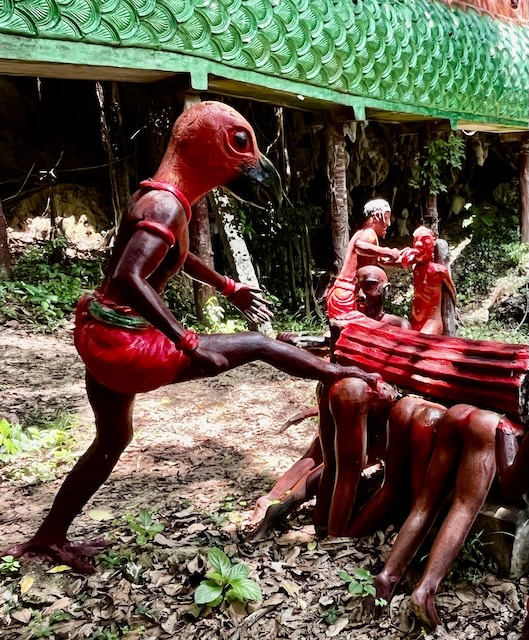
The scenes are a visual sermon on karma
No visit to Phang Nga town is complete without a stop at Wat Tham Ta Pan — and nothing in Thailand had quite prepared us for it. Located about 100 kilometres northeast of Phuket, this is a heaven and hell temple, though “heaven and hell” hardly does justice to what awaits inside.
At the entrance, a fountain features five monk sculptures, each holding a bowl that represents wealth, beauty, happiness, cleverness, and health. It feels serene enough. Then you step into the mouth of an enormous dragon. You wind through the belly of the beast, down a dark, damp tunnel lit only by wisps of light filtering through a few windows — and when you emerge at the other end, you are in hell.
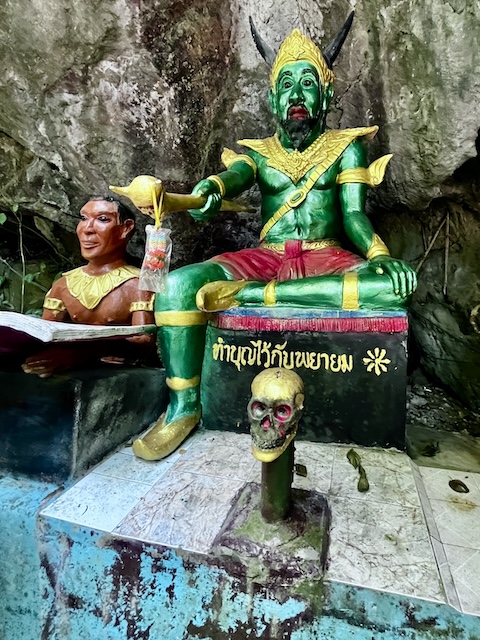
Satan, the chief of the hell garden
The Hell Garden is filled with life-sized statues vividly depicting the torments of Buddhist Naraka — sinners being boiled in cauldrons, having their tongues pulled out, suffering fates tied directly to their earthly misdeeds. Some figures are being speared or strangled, others forced to climb spiked trees, many finished with vivid red paint to highlight their fresh wounds. It is confronting, extraordinary, and — when you understand its purpose — strangely moving. The scenes are not designed for shock alone; they are a visual sermon on karma, intended to make the consequences of negative actions visceral and impossible to ignore.
Beyond the dragon and the hell garden, the temple opens into something altogether different: a cave reached by a dark track with bridges crossing an underground stream, leading to a meditation space with small Buddha statues — peaceful and entirely removed from the mayhem outside. There is also a steep staircase leading to a rooftop viewpoint over Phang Nga town and its surrounding limestone peaks. Take it slowly going up. The view at the top is worth every step.
Entry is free. Donations are welcome. Not recommended for young children.
Our Base: Baan Ati Resort & Spa
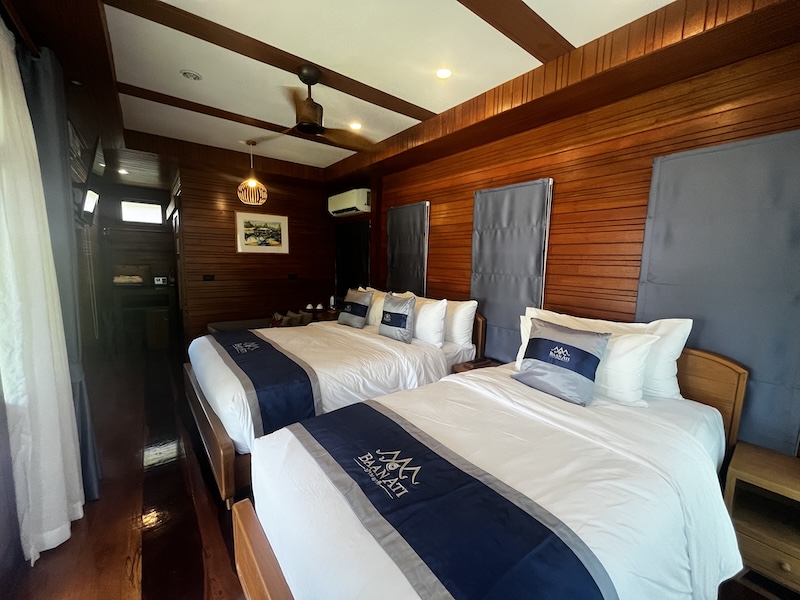 The Asian Itinerary team’s stay was kindly hosted by Baan Ati Resort & Spa. The resort is nestled along a serene canal in the Natai area of Phang Nga, and offers charming wooden stilt villa-style accommodations surrounded by tropical gardens and mountain views. Each villa features private living space, a shaded veranda, and access to the resort’s pool, spa, and restaurant.


