
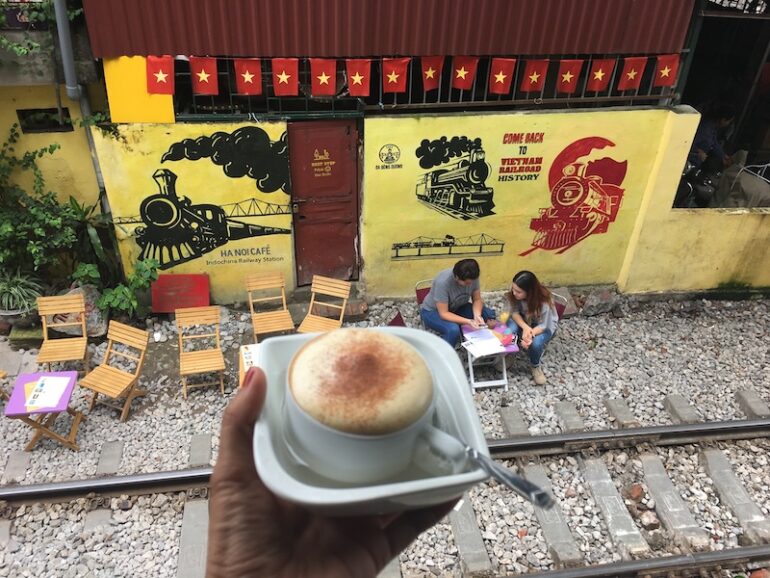
There’s a coffee you don’t expect. Not because of its color or its aroma, but for what it hides inside: an egg yolk whipped into a sweet, creamy cloud. You discover it while walking through the streets of Hanoi, in Vietnam, among the scents of a city that never sleeps. Plastic tables take over the sidewalks, stools sit low to the ground, and everywhere people sip something dark, topped with a pale yellow, almost golden foam. It doesn’t look like coffee. And yet, it is.
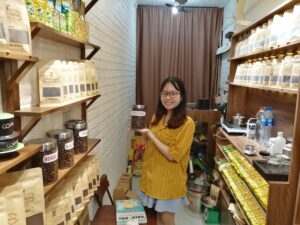
Café Giang, at 39 Nguyen Huu Huan Street
Cà phê trứng, Vietnam’s egg coffee, is neither a tourist gimmick nor a modern culinary experiment. Its story begins in wartime, when milk was scarce and hunger outweighed tradition. It was 1946 in Hanoi, and Nguyen Van Giang, a bartender at the Sofitel Legend Metropole — then an elegant French colonial residence — faced empty shelves. Coffee was plentiful; Vietnam, though not yet the global giant it would become, had inherited coffee cultivation from the French in the Central Highlands. But fresh milk was nowhere to be found. And without milk, there was no café au lait for European guests who demanded it every morning.
Giang glanced at the kitchen, spotted the eggs — always available, even in the hardest times — and thought: why not try? He beat an egg yolk with sugar and condensed milk, added a touch of butter, until he achieved a thick, velvety cream. He poured it over a cup of hot, bitter Robusta coffee, served in a glass. The result was astonishing: not a compromise, but a revelation. That golden foam softened the bitterness of the coffee, transforming it into something new, almost dessert-like. At first the guests were surprised, then intrigued, and finally enchanted.
Thus, in the heart of a war-torn city, one of Southeast Asia’s most iconic drinks was born. Giang left the hotel and opened Café Giang, at 39 Nguyen Huu Huan Street. It still stands today, on the second floor of a modest building, with worn walls and windows open to the city. No flashy signs are needed: just follow the aroma in the air, the sound of egg yolks being whisked by hand, and the waiters rushing up and down with steaming trays. Giang’s son, Tri Hoa Nguyen, still prepares the coffee using the original recipe, with a secret ingredient never revealed. Perhaps a touch of brandy, perhaps a special honey. Or perhaps it’s just time itself, turning necessity into legend.
I wasn’t looking for this drink. I didn’t even know it existed. After a bowl of phở, sitting on a chair far too low, I just wanted a coffee. A real coffee. For us Italians, it’s a matter of principle: coffee is not a break, it’s a ritual, a pleasure.
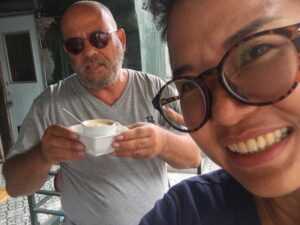
The author with a good cup of egg coffee
And yet, too often while traveling I’ve had to give it up. In many countries it’s too long, watered down, lukewarm. Or it’s instant — that gray broth “not even fit for dogs.” So I learned to make do, reluctantly, with whatever was available. But in Hanoi, things were different. On the menu I read simply cà phê trứng. I asked what it was, hesitated: a raw egg in coffee? It could have been a gastronomic nightmare, if I hadn’t already tasted something similar in Bologna. Then I thought: if you’ve come all this way to explore local cuisine, you can’t stop at the threshold of taste. You must cross it.
The first cup arrived hot, steaming, with that yellow cream trembling slightly. I stirred it slowly with a spoon, watching the dark coffee rise to the surface. Then I tasted. A cautious sip, and immediately I understood: it wasn’t just coffee, it wasn’t dessert, it wasn’t liquid or solid. It was a unique balance of bitter and sweet, warmth and creaminess. It recalled a liquid tiramisù, a coffee zabaglione, a crème brûlée you could drink. But most of all, it was good. Deep. Comforting.
Since then, every time I’ve returned to Hanoi, egg coffee has been a ritual I never miss. A mandatory stop was Ciao Coffee, connected to the tour operator Ciao Travel, which until my last visit stood just beyond Chuong Gate. Despite its Italian-sounding name, it was a purely Vietnamese place, where skilled hands offered true delights to my palate.
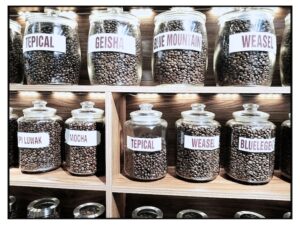
various qualities of coffee you. an find in Hanoi
Watching Ms. Nhung whisk an egg yolk, even now with the help of an electric mixer — an inevitable concession to modern times — remains a gesture of resistance against the rush. It’s a ritual, slow and meditative. And as I wait, I think about the strange destiny of food: how often what is born from scarcity becomes a symbol of abundance.
Today, the tour operator I collaborate with has moved about a kilometer away and closed its restaurant section. But Ms. Nhung is still there, and she promised me that every time I return to Hanoi, she’ll prepare her unmistakable, exquisite egg coffee.
Coffee, after all, is a story of adaptation, ingenuity, and dignity. It’s proof that when what you think is essential is missing, you can create something new, even better. It’s no coincidence that Vietnam, now one of the world’s top three producers, is home to such a unique specialty. Here, coffee is not a borrowed culture but a living part of national identity.

antichi macina caffè
Condensed milk, another symbol of this tradition, was introduced by the French during World War I to compensate for the lack of fresh milk. The Vietnamese adopted it and made it their own: today a simple cà phê sữa means black coffee, brewed with a phin filter, blended with a generous spoonful of condensed milk.
But cà phê trứng goes beyond. It’s a poetic evolution of the same principle: turning what you have into something memorable. Today, there are versions with coconut milk, cocoa, or served cold with ice. I myself tried to make it at home. I followed every step of Ms. Nhung’s ritual. Decent, yes. But it’s not the same. It lacked the trained, skilled hand. It lacked the air of Hanoi, the noise of traffic, the feeling of being in a place where time moves differently. It lacked the barista who looks at you and smiles, as if knowing you’ve just crossed an invisible border.
Today, egg coffee is no longer just Hanoi’s treasure: you’ll find it in Saigon, Hue, Hoi An. In trendy cafés it comes in elegant glasses, ready for Instagram. But the heart remains in the old quarter, where someone walks in every day, looks at the cup with suspicion, and then says: “It’s good. I don’t know what it is, but it’s good.”
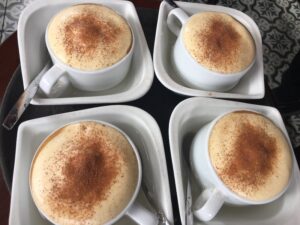
vietnamese egg coffee
And that, perhaps, is the true miracle of cà phê trứng: it doesn’t win you over immediately; it challenges you. But once you try it, you realize it’s not the flavor that changes you, but the very idea of coffee. That doesn’t have to be bitter, quick, and functional. It can be soft, slow, and complex. It can be a moment you don’t fully understand, but one that feels right.
Because sometimes, the most authentic pleasure doesn’t come from what you know, but from what you don’t expect.
Photos by Guglielmo Zanchi (Pluto)


