
Cambodia has entered a new era of travel with the official opening of Techo International Airport (KTI), the country’s largest aviation project and one of the world’s biggest airports by land area.
A New Gateway to Phnom Penh
Located just south of Phnom Penh, KTI is designed as a modern hub that will transform the way travelers, businesses, and investors connect with Cambodia. The airport’s first commercial flight, operated by Air Cambodia and greeted with a ceremonial water salute, marked the beginning of this historic milestone.
Developed by Cambodia Airport Investment Co., Ltd. (CAIC) — a joint venture between the Overseas Cambodian Investment Corporation (OCIC) and the State Secretariat of Civil Aviation (SSCA) — the airport reflects Cambodia’s growing commitment to infrastructure and regional connectivity.
With an initial capacity of 13 million passengers annually, KTI is set to enhance tourism, expand trade routes, and position Phnom Penh as a competitive aviation hub in Southeast Asia.
Global Partners for World-Class Standards

Exterior shot of the new Techo International Airport Cambodia
To deliver international-quality service, CAIC has partnered with industry leaders including Vinci Airports, Lagardère Travel Retail, Newrest, and Singapore Airlines Engineering Company (SIAEC). Their combined expertise ensures top-class operations, dining, shopping, and aircraft maintenance, helping KTI expand regional and long-haul connectivity in the years to come.
“Welcoming the first passengers at Techo International Airport is a defining moment,” said Pung Kheav Se, Chairman of OCIC and CAIC. “It opens new doors for Cambodia’s visitors, businesses, and investors, while shaping a stronger future for our nation.”
Architecture Inspired by Khmer Heritage
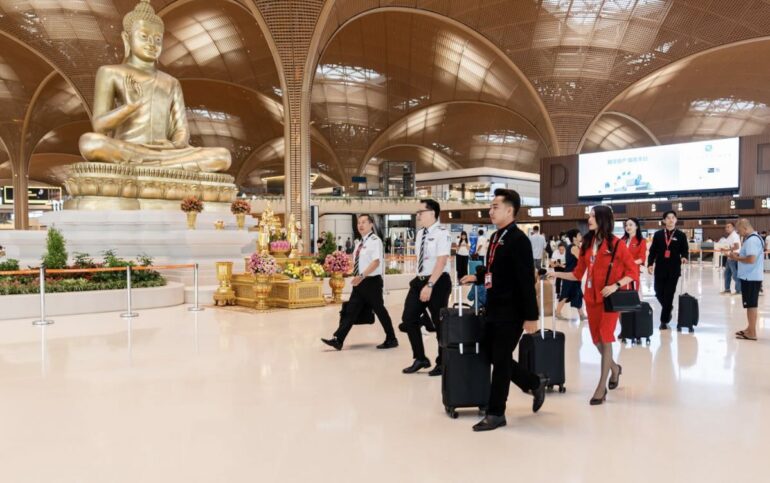
Designed by the renowned British firm Foster + Partners, the terminal showcases a striking blend of Khmer tradition and contemporary architecture. Bamboo-patterned domes reflect Cambodia’s weaving culture, while a nine-meter Buddha statue in the Abhayamudra pose welcomes passengers with peace and protection.
This unique design not only emphasizes cultural pride but also embraces sustainability, symbolizing Cambodia’s vision of progress rooted in tradition.
A Landmark Project by OCIC
The launch coincides with the 25th anniversary of OCIC, one of Cambodia’s most influential conglomerates. Over the past two decades, the group has contributed to the country’s transformation through real estate, infrastructure, healthcare, education, and industrial projects. With more than 10,000 homes, bridges, and flyovers built, the new Techo International Airport stands as OCIC’s most ambitious achievement to date.
What It Means for Travelers

The first passengers arrive at Techo International Airport
For visitors, KTI represents easier access to Cambodia’s rich cultural and natural attractions — from the temples of Angkor Wat to the beaches of Sihanoukville and the vibrant streets of Phnom Penh. The airport will streamline travel experiences, offering modern facilities, wider flight options, and smoother connections.
As Cambodia strengthens its position in regional and global air networks, KTI is more than an airport — it is a gateway to discovery.
For more on Cambodia’s tourism and travel updates, visit the Ministry of Tourism Cambodia.


