
Off the southwest coast of Lombok, away from the crowds and noise of the famous northern Gili Islands, lies a corner of Indonesia that seems to have escaped the rush of mass tourism. Here, time moves at an ancient pace, dictated only by the rhythm of the tides, the whisper of the sea breeze, and the changing colors of the daylight. This is an area little known to most, yet rich in authenticity: the coast of Sekotong, a starting point for a quiet journey to three tiny islands of sand, coral, and wild vegetation — Gili Nanggu, Gili Tangkong, and Gili Kedis.
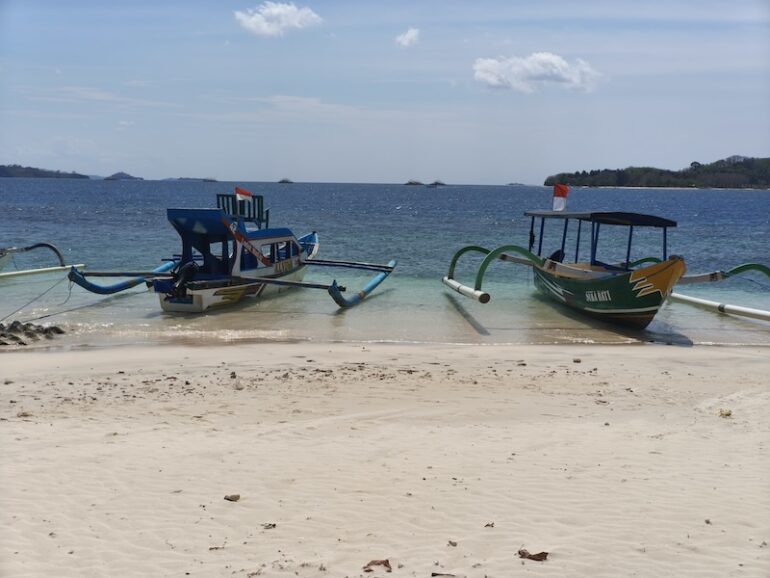
Getting to these islands isn’t your typical tourist operation. There are no fast ferries or crowded docks. Instead, departures are from small, often improvised wooden piers, aboard traditional boats called perahu, used by local fishermen. These simple, narrow wooden boats with side oars are built for stability even in choppy waters. Boarding a perahu means leaving behind, at least for a few hours, the comfort of modern infrastructure and trusting a vessel that lives in harmony with the sea. The engine, often a basic outboard motor, produces a steady hum, while the boat glides over crystal-clear water, leaving a gentle wake. It’s a sensory experience: feeling the gentle sway of the hull, smelling the salty air, watching the seabed appear and vanish beneath the keel. Navigating between these islands isn’t just a physical transfer; it’s a way to connect directly with the environment, its fragility, and its silent strength.
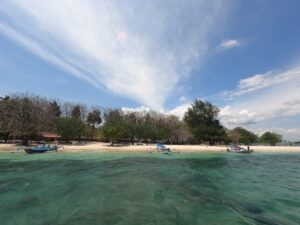
The first to appear on the horizon is Gili Nanggu, the largest and most developed of the three. From afar, it’s recognizable by its rounded shape and almost entirely forested surface. As the perahu approaches the shore, the transparency of the water strikes you: in some spots, it looks as if there’s no water at all, just liquid air. You don’t need to dive to enjoy the underwater spectacle; walking along the shoreline reveals colorful fish swimming among vibrant, well-preserved coral formations. The beach is broad, with fine white sand shaded by casuarina trees and some palms. The atmosphere is almost unreal in its calm. There are no shops, no paved roads, no loudspeakers or background music. Only the rustling of leaves in the wind, the occasional call of a seabird, and the gentle lapping of waves on the shore.
Gili Nanggu also offers rustic-style bungalows managed by local families, but even those who don’t stay overnight can enjoy this island as if it were an open-air natural park. It’s an ideal place for those seeking an immersive experience in nature, without sacrificing some comfort or compromising authenticity. Swimming here is a rare pleasure: the water is warm, clear, and shallow, and the coral reef is reachable on foot in just a few minutes. Turtles often swim peacefully among the corals, testifying to the health of the ecosystem.
Not far away, almost appearing in a tiptoe, is Gili Tangkong. If Nanggu is welcoming and generous, Tangkong is reserved and almost shy. It’s smaller, wilder, and often uninhabited for most of the day. Its dense vegetation almost reaches the beach, creating deep shaded spots perfect for solitude. There are no tourist facilities or marked trails. Walking around its perimeter often means being the only person present for hours. The footprints left in the sand are the first of the day—and perhaps the last.
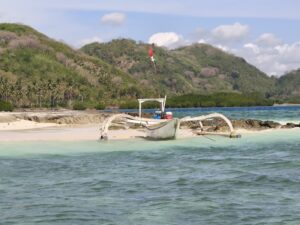
Lombok secret islands Nanggu Tangkong Kedis
This island invites contemplation more than underwater exploration. It’s the perfect place for those who want to disconnect completely and seek an intimate connection with nature, without intermediaries. The seabed here is just as transparent but feels more intimate and secluded. The sea seems to embrace the island in a protective hug, making it an ideal refuge for those looking to find their inner rhythm. Unlike busier islands, there’s no pressure to “see” or “do.” You simply need to be present, and the place reveals itself naturally.
Finally, just a few hundred meters away, stands Gili Kedis — a true mirage of sand. Calling it an island is almost an understatement; it’s better described as a tiny white sandbank, just a bit larger than a tennis court, surrounded by surreal turquoise waters. There are no real trees—only a few low shrubs and smooth rocks shaped by the waves. The landscape is minimalist, essential, almost abstract. Yet, perhaps because of this, Gili Kedis exerts a magnetic charm. It’s the archetype of a deserted island, a place many dream of but few actually encounter.
Its small size allows you to walk around it in just a few steps, but that very smallness makes it so powerful. Standing in the center of Gili Kedis, your gaze takes in the entire horizon in a single turn. There are no distractions, no extraneous elements—only sea, sky, and sand. It’s easy to understand why many visitors describe it as an almost meditative experience. Depending on the tides, Gili Kedis appears more or less expansive: sometimes seeming to emerge from nothing, other times blending seamlessly with the level of the sea. This fragility is part of its character, a silent reminder of the delicate balance of nature.
Together, these three islands tell a different story of Indonesia — one far from the well-trodden routes and commercialized experiences. They are not places to “consume” quickly, to photograph and leave behind. They are spaces to listen to, to respect, to live slowly. Each has a distinct character: Nanggu, generous and welcoming; Tangkong, intimate and wild; Kedis, essential and almost metaphysical. Yet, they share a common atmosphere: that of a world still in balance, where nature isn’t just a backdrop but the protagonist.
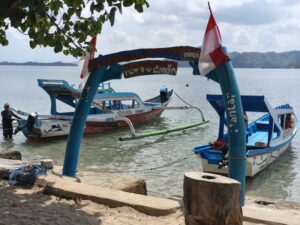
Traveling between them on a perahu becomes a rite of passage. Each move is a moment of reflection, an opportunity to observe the sea from a different perspective, to notice how the shades of water change with depth, to see local fishermen at work with traditional methods. There’s no rush, no strict schedule. Time here is measured in breaths, not hours.
Visiting the Gili Islands of southwest Lombok isn’t just an excursion but an invitation to rediscover the value of silence, natural light, and simplicity. In an age where everything seems to accelerate, these small islands offer a rare space: the pause, contemplation, and authentic contact with the environment. Perhaps because of this, they leave a much deeper impression than many other places.
Photos by Guglielmo Zanchi (Pluto)


