
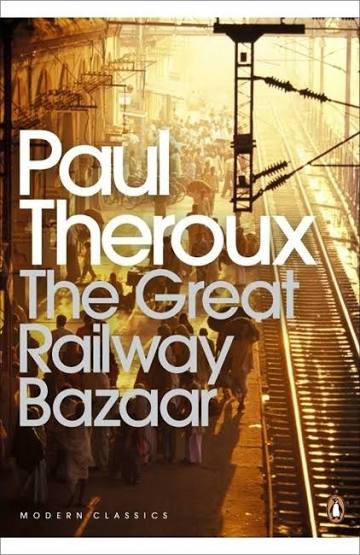
There is a particular kind of romanticism attached to train travel that airplanes have never managed to kill. The rhythmic clatter of wheels on steel, the slow unraveling of landscapes outside the window, the forced intimacy with strangers in a shared compartment—these are the ingredients of a journey that feels, even today, fundamentally human. Paul Theroux understood this instinctively. In 1973, armed with a notebook and an insatiable curiosity, he boarded a train in London and set off on a four-month odyssey that would take him across Europe, through the Middle East, deep into the Indian subcontinent, up through Southeast Asia, and finally to Japan—before turning around and making the long journey home via the Trans-Siberian Railway. The result is The Great Railway Bazaar, a travelogue that has become a classic of the genre and remains, half a century later, one of the most compelling accounts of overland travel through Asia ever written.
A Journey Without a Destination

Paul Theroux
What makes The Great Railway Bazaar so remarkable is that it is not really about the destination at all. Theroux is not a man in a hurry. He is not ticking off monuments or chasing the perfect photograph. He is, instead, a connoisseur of the spaces between places—the dining cars, the station platforms, the cramped compartments where strangers become temporary companions, sharing tea, stories, and the peculiar camaraderie of the long-distance traveler.
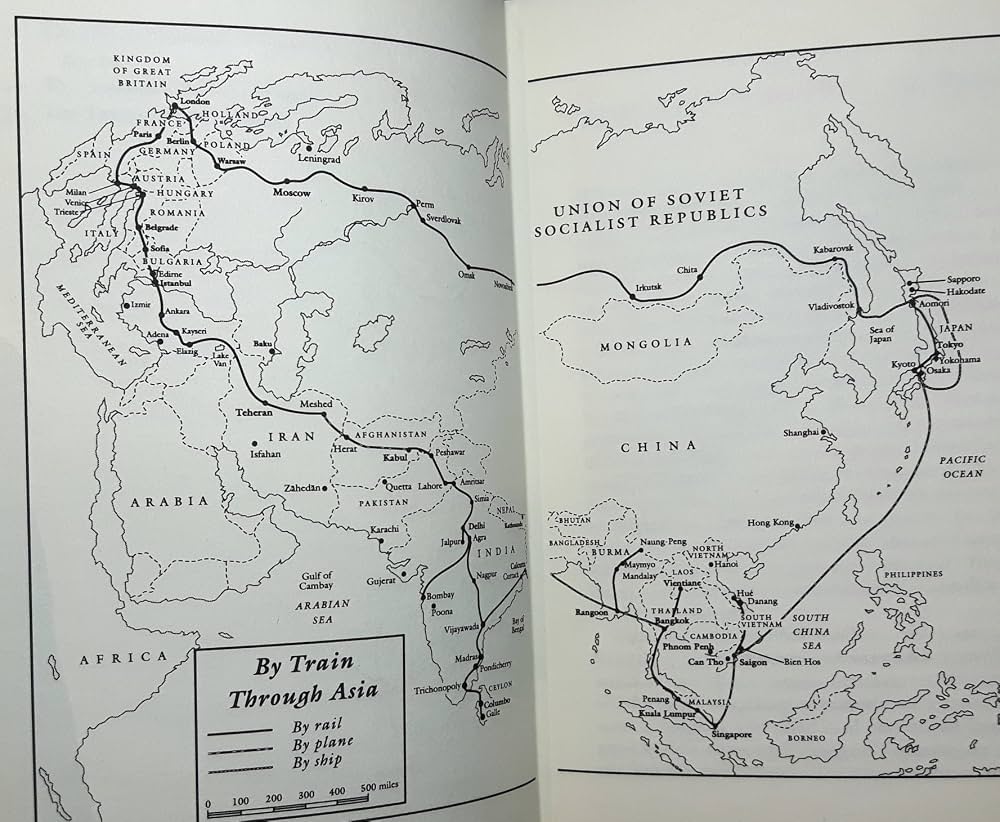
His route is ambitious: the Orient Express to Istanbul, the Taurus Express through Turkey, the famous Khyber Pass, the Grand Trunk Express across India, the narrow-gauge railways of Ceylon (now Sri Lanka), the Reunification Express through Vietnam during the final, chaotic months of the war, and onward through Burma, Thailand, Malaysia, and Singapore. From there, he travels to Japan, where he boards the bullet train—a symbol of a modernity that feels jarringly out of place after months of slow, steam-powered travel—before beginning the long, frozen journey back to Europe aboard the Trans-Siberian Railway.
It is a journey that would be exhausting to replicate today, and perhaps impossible in the exact form Theroux experienced it. But that is precisely why the book remains so valuable. It is a time capsule, a record of a version of Asia that has, in many places, vanished—replaced by high-speed rail, modern highways, and the relentless homogenization of global travel.
The People You Meet
 Theroux is not always a likable narrator. He can be curmudgeonly, judgmental, and occasionally dismissive of the cultures he passes through. But he is never boring. His greatest gift as a writer is his eye for character, and The Great Railway Bazaar is populated with a cast of unforgettable figures: the Polish widower who drinks too much and talks too loudly, the mysterious Japanese man who seems to appear on every train Theroux boards, the Indian family who adopts him for a day, the fellow travelers who drift in and out of his compartments like characters in a novel.
These encounters are the heart of the book. Theroux understands that travel is not just about seeing places; it is about meeting people, and the train is the perfect vessel for such meetings. It is a place where social boundaries dissolve, where strangers are forced into proximity, and where conversations take unexpected turns. The dining car, in particular, becomes a recurring stage for these exchanges—a place where Theroux, often alone, invites himself into the lives of others and listens with a writer’s ear.
Asia Through the Window
 For readers with a particular interest in Asia, The Great Railway Bazaar offers a fascinating, if occasionally uncomfortable, portrait of the continent in the early 1970s. Theroux travels through India at a time of political turbulence and widespread poverty; through Vietnam as the war grinds toward its bitter end; through Burma under the tight grip of military rule; through Thailand, Malaysia, and Singapore on the cusp of their economic transformations.
His observations are sharp and often unsentimental. He does not romanticize poverty, nor does he shy away from describing the squalor, the heat, the chaos, and the sheer sensory overload of traveling through Asia by train. But neither does he reduce the places he visits to caricature. There is a genuine curiosity at work here, a desire to understand rather than simply to judge.
For today’s travelers, reading The Great Railway Bazaar is a reminder of how much has changed—and how much has not. The trains are faster now. The stations are cleaner. The internet has made the world smaller. But the essential experience of traveling through Asia by rail—the long hours, the unexpected encounters, the sense of distance and time slowly collapsing—remains remarkably intact.
The Trans-Siberian and the Long Way Home
The final section of the book, in which Theroux travels from Japan to the Soviet Union and then across the vast expanse of Siberia to Moscow, is a masterful conclusion. The tone shifts; the air grows colder, the landscapes emptier, the mood more contemplative. After months of movement, there is a sense of weariness, of longing for home, that gives the book an emotional weight it might otherwise lack.
It is a reminder that all journeys, no matter how grand, eventually end. And that the return home is as much a part of the adventure as the departure.
A Classic of Travel Literature
 The Great Railway Bazaar is not a perfect book. Theroux’s judgments can feel harsh, his tone occasionally self-indulgent, and some readers may find his relentless focus on the grimmer aspects of travel off-putting. But these are minor criticisms in the face of the book’s considerable achievements. It is a work of genuine literary merit, a travelogue that transcends its genre and becomes something closer to a novel—a portrait not just of a continent, but of a traveler, and of the strange, beautiful, exhausting experience of moving through the world at ground level.
For anyone planning a journey through Asia, whether by train or otherwise, The Great Railway Bazaar is essential reading. It is a reminder that travel is not just about the places we go, but about the people we meet, the stories we collect, and the person we become along the way. It is also, quite simply, a joy to read.
Book: The Great Railway Bazaar: By Train Through Asia
Author: Paul Theroux
First Published: 1975


