
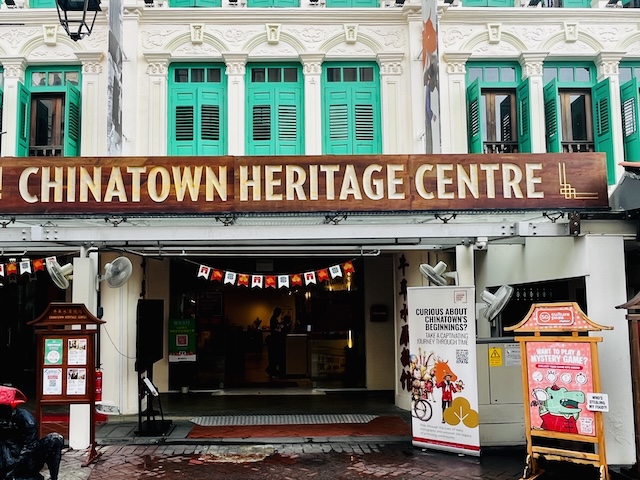
Singapore is a city of dazzling futures. But its past is alive on Pagoda Street. I visited the Chinatown Heritage Centre on the morning of 26 May as part of my media trip. I expected a small museum. What I found was a time capsule – three beautifully restored shophouses where the stories of sinkheh (new guests), coolies, Samsui women, Chettiars, Chulias and Baweanese migrants breathe again.
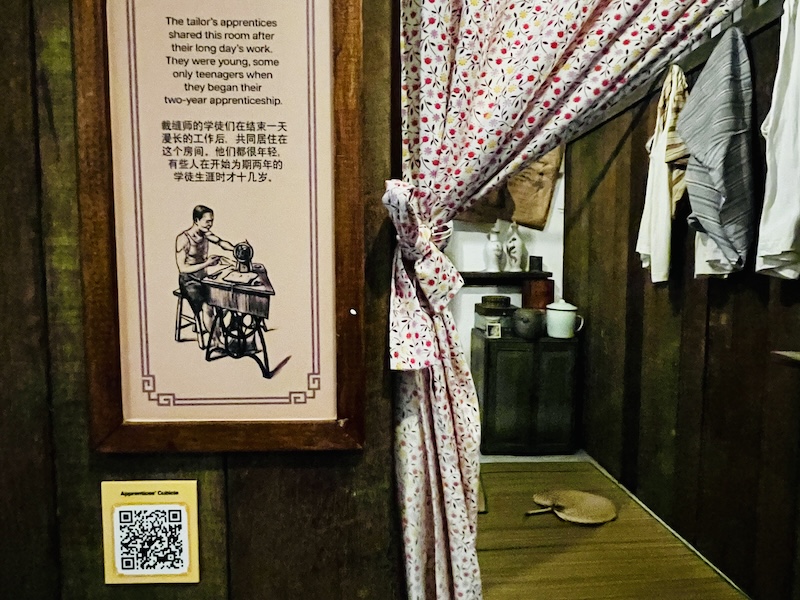 From the moment I stepped inside, I understood why this is the only place in Singapore that has meticulously recreated the original interiors of 1950s shophouse tenants. No glass cases. No velvet ropes. Just the creak of wooden floors, the scent of old timber, and the echo of lives once lived in cubicles no larger than a double bed.
A Warm Welcome
At the entrance desk, I was greeted by Cristina and Goh. Their smiles were genuine, their kindness immediate.
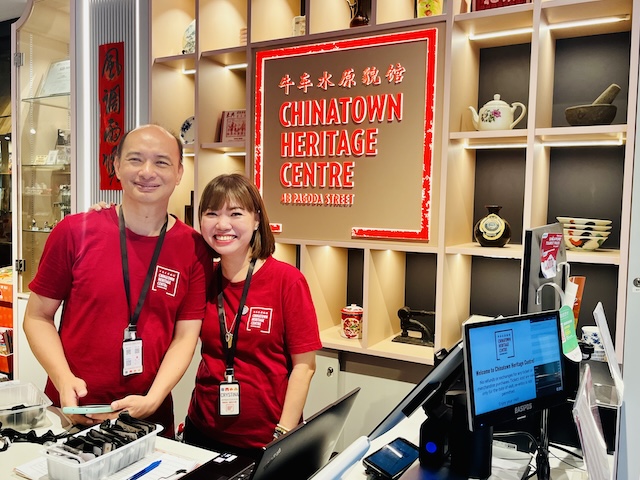
Cristina and Goh with their genuine smiles
You can tell immediately: these are people who love this place. They are not just staff; they are custodians of memory.
Goh carefully instructed me on how to follow the visitor footprint. Later, he would tell me, proudly, that the record visit lasts four hours. I believe him. My own visit flew past – two hours were not nearly enough.
A Sensory Journey Back in Time
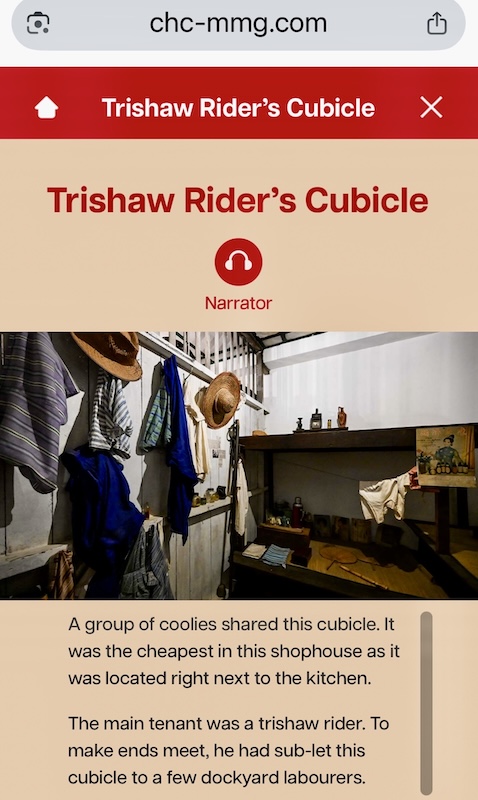
QR codes allow visitors to scan and get deeper information
The Centre is spread across three floors. What makes Chinatown Heritage Centre extraordinary is its immersive soundscape. In every room, loudspeakers recreate the sounds of daily life: a tailor’s sewing machine stitching endless orders, footsteps climbing a wooden staircase, doors screeching on rusty hinges, people chattering in Hokkien, Cantonese, Teochew, Tamil, Malay, and cats miaowing in back alleys. You don’t just see the past. You hear it. You feel it. Also, Throughout the museum, QR codes placed near each display and room allow visitors to scan and instantly access deeper information about what they are seeing — a small but thoughtful touch that enriches the experience without cluttering the space.
The Greater Town (Tua Po)
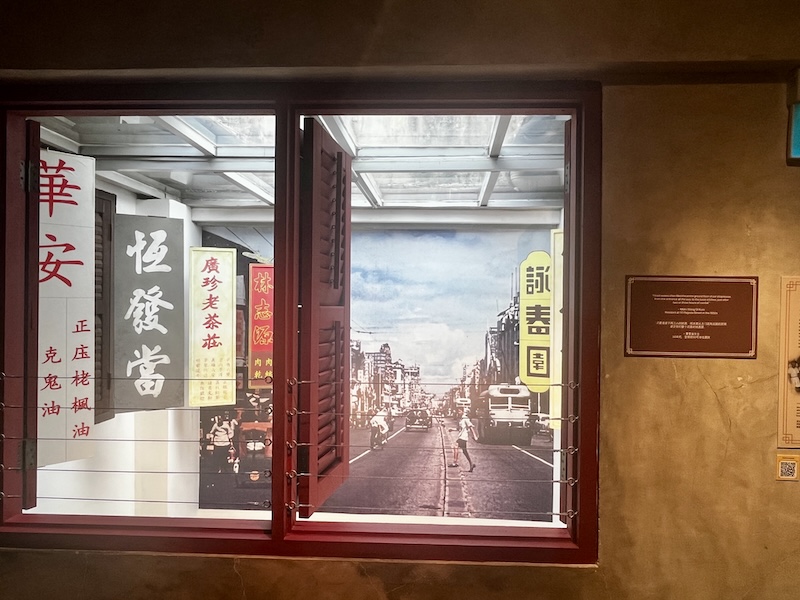
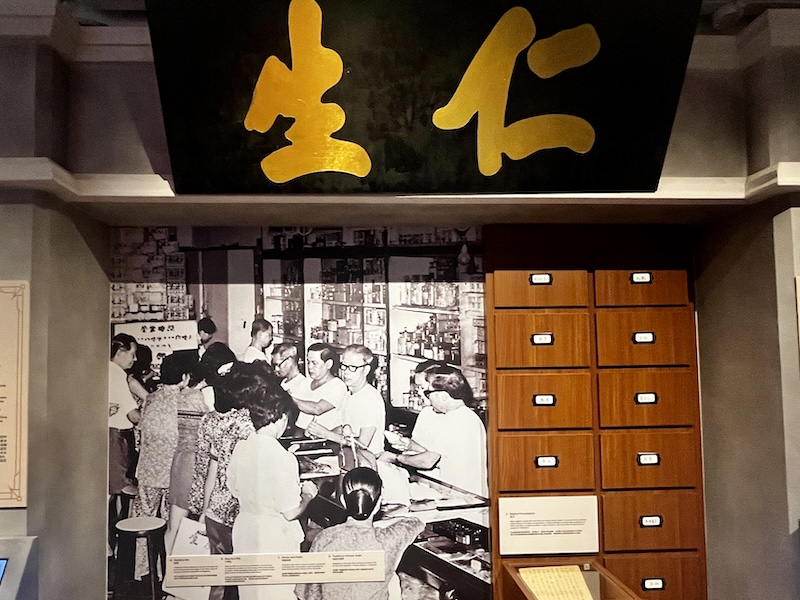 After Raffles established Singapore as a free port in 1819, the Chinese were assigned the south bank of the Singapore River – then a swampy, forested swathe. The Hokkien settled along Telok Ayer Street, the Teochew along Merchant Road, the Cantonese in the core of Chinatown. This area became known locally as Tua Po – the ‘greater town’. Today’s Chinatown still bears the mark of the different ethnic groups that set up places of worship here, many of which still serve the community.
Where the Sinkheh Lived
 The heart of the museum is on the second floor. Here, you walk through the actual cubicles where migrants lived. One display stopped me completely: a tiny cubicle no larger than a modern walk-in closet. Inside, a wooden bed shared by four men sleeping in shifts. The Cantonese called these infamous living quarters zyu zai kun – literally ‘piglets pen’. Cramped, unsanitary, and yet, this was home.
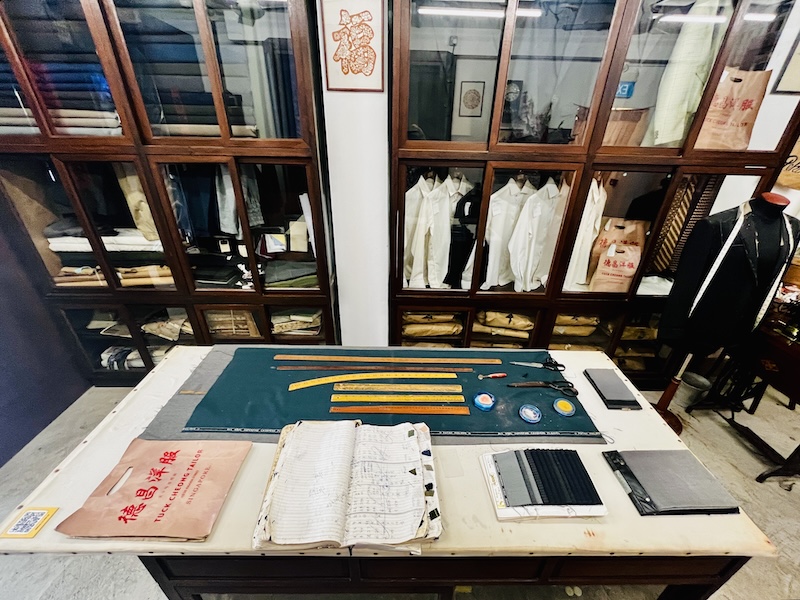
A tailor shop from times past
I saw a tailor’s workshop, a letter writer’s corner (many sinkheh were illiterate and relied on public scribes), and a coolie’s cubicle with nothing but a rattan mat and a wooden chest.
The Sinkheh: New Guests, Old Dreams
Between the 19th and mid-20th centuries, millions left China driven by famine, floods and unrest, making their way to Nanyang, the southern seas. They were called sinkheh – ‘new guest’ in Hokkien. On the wall, I read an excerpt from the “Rhyme of the Migrants”: “Whether there are earnings or none, return early / Do not let your family wait.” I read it twice. The second time, my eyes were wet.
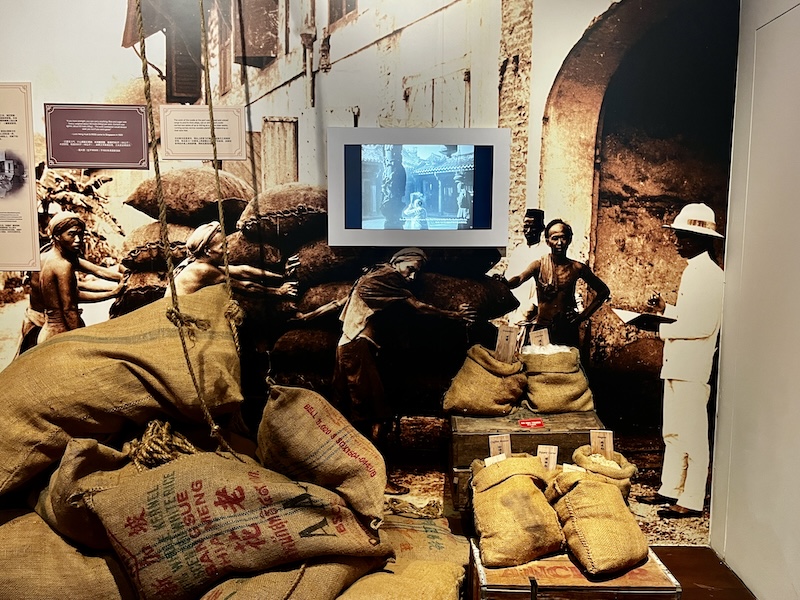
Most sinkheh ended up as manual labourers
Life as a Coolie
Most sinkheh arrived unskilled and ended up as manual labourers – coolies, from the Chinese ku li (hard labour). Some came as indentured coolies, sold like cattle in the market. Their work was brutal: each coolie carried two sacks of up to 100 kg on their backs, running across narrow wooden planks while balancing on bare feet. A photograph from the early 1900s shows their faces. No resentment. Only exhaustion and resilience.
A Multi-Ethnic Chinatown
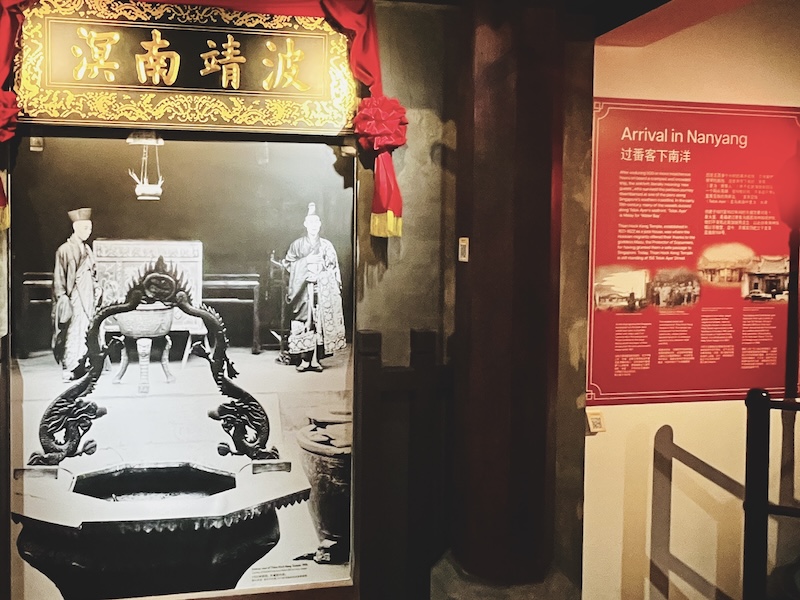
Chinatown Heritage Centre Singapore
One of the most important lessons of Chinatown Heritage Centre is that early Chinatown was already multi-ethnic. The Chulias (Tamil Muslims) settled along Cross Street. The Chettiars, known as moneylenders, flourished at Market Street. The Baweanese from East Java lived in pondoks around Club Street, practicing merantau – a rite of passage where young men leave home to seek fortune. One photograph from the early 1900s shows Chinese, Indian and Malay immigrants co-existing on the same street. This is not a detail. This is the heart of Singapore’s story.
Moving Images and Living Memories
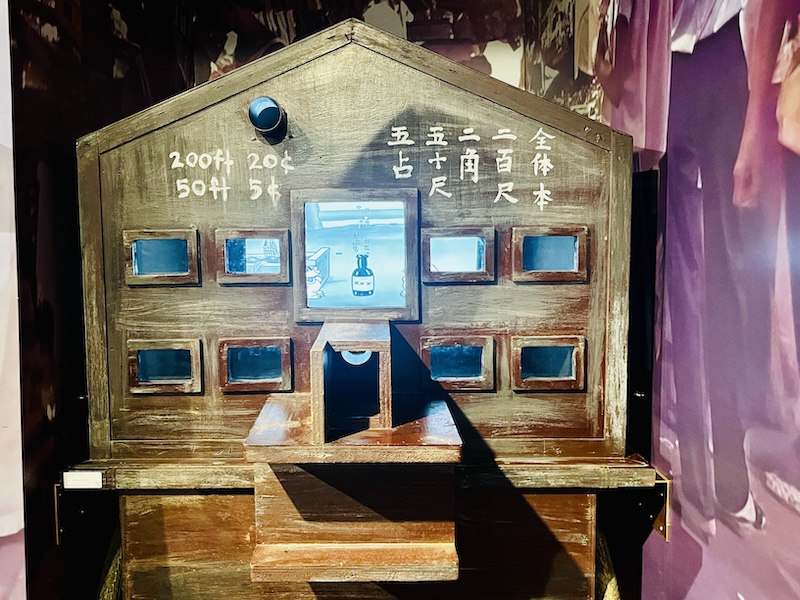
One of the first cinemas-on-wheels
The third floor features a short film with haunting visuals: rickshaws, crowded piers, street wayang (Chinese opera), and the first cinemas-on-wheels. Speaking of street wayang: colourful costumes, lively music, dramatic stagecraft – it was something every Chinatown resident looked forward to. Singapore’s oldest opera troupe, Lao Sai Tao Yuan Teochew Opera, was founded in 1864 and still performs today.
And then there were the storytellers (gong gu lao). When night fell, they would sprinkle water to cool the air, lay straw mats, light an incense stick to keep time, and transport their audience – mainly labourers and the illiterate – to another realm. Before television arrived in the 1960s, the storyteller was the cinema of the people. Even the Cinema-on-Wheels is here: a wooden movie box mounted on a tricycle. I smiled. Then I felt grateful that such memories were preserved.
Amacha Tea Shop & Museum Shop
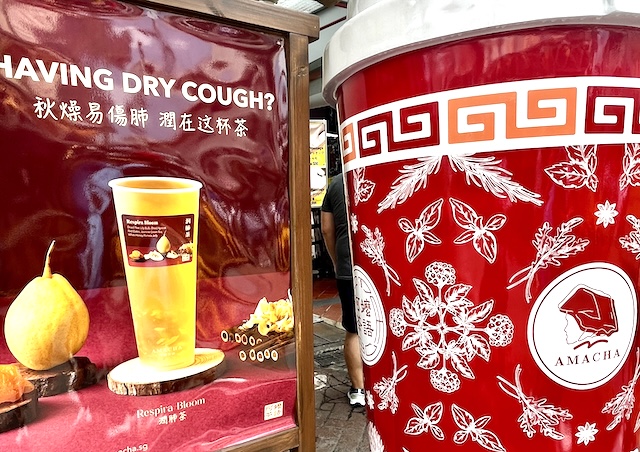
Amacha Tea Shop
At the end of my visit, Cristina handed me a 20% voucher for the attached Amacha Tea Shop, which specialises in herbal healthy remedies and lapis cakes. I bought a box of lapis sagu and a cooling chrysanthemum tea. Both were excellent. The museum shop sells heritage souvenirs and old photographs. I picked up a small print of Pagoda Street circa 1900. A fitting memory.
Final Verdict
The Chinatown Heritage Centre is not a glossy museum. It is for those who want to understand how Singapore came to be. You will walk through cubicles where families of ten slept side by side. You will hear the screech of doors that once closed on tired coolies. You will read poems written by illiterate migrants who only wanted to go home. And you will leave with a profound respect for the resilience of the human spirit.
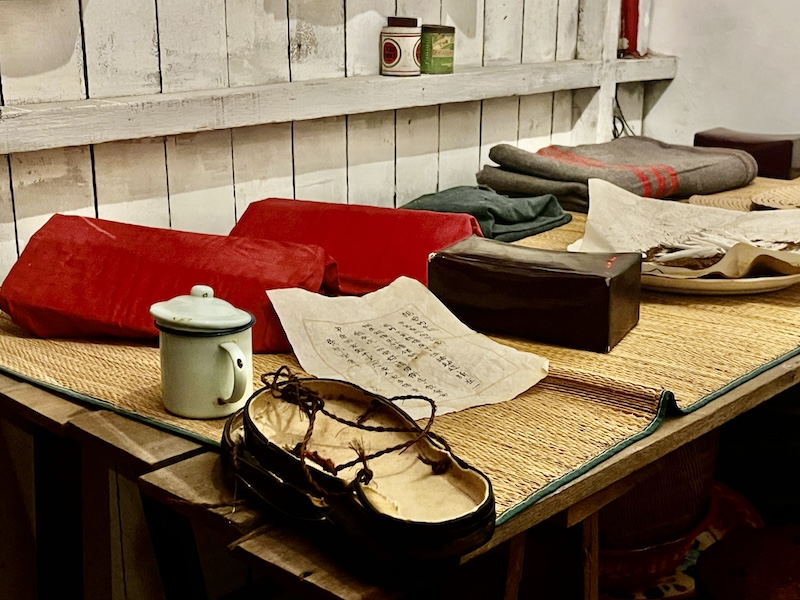
The room of the sandal maker
Goh told me the record visitor stayed inside for four hours. I believe him. Two hours were not nearly enough. Next time, I will book a whole day.
Practical Information
|
Detail |
Information |
|
Address |
48 Pagoda Street, Singapore 059207 |
|
Nearest MRT |
Chinatown MRT (Exit A) |
|
Opening Hours |
Daily, 10:00 AM – 8:00 PM (Last entry: 7:15 PM) |
|
Website |
 Disclosure & Thanks
My visit was sponsored by Chinatown Heritage Centre as part of my media trip to Singapore. Sincere gratitude to Yi Qi for inviting me. All opinions, words and images are my own.


