
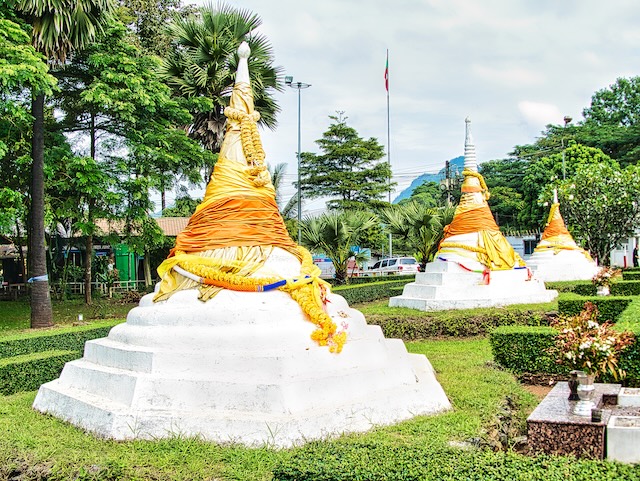
The road to Sangkhlaburi unspools westward from Kanchanaburi through increasingly rugged terrain, the jungle pressing close on either side. After roughly three hours, the landscape opens onto a small town straddling a river, and beyond it, a cluster of three white stupas marks the edge of the map. This is the Three Pagodas Pass—the westernmost frontier of Thailand, and a place where the idea of a border becomes something you can stand beside, photograph, and contemplate.
During our media trip to Kanchanaburi province for the Tourist Authority of Thailand in Italy, we made the long drive to this remote checkpoint. It is not a place that offers spectacle in the conventional sense. The pagodas themselves are modest—three octagonal-based stupas, whitewashed and pointed, standing perhaps six meters tall and spaced a few meters apart. But their significance is disproportionate to their size.
A Gateway Between Worlds
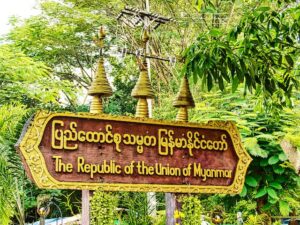 The pass has been a corridor between the Indian subcontinent and Southeast Asia for centuries. It is believed that Indian monks crossed through this gap in the Tenasserim Hills as early as the 3rd century, carrying Buddhism into what is now Thailand. For traders and travellers, it was the most practical land route through an otherwise forbidding mountain range.
The strategic value of this geography was not lost on armies. In 1548, the Burmese king Tabinshwehti used the pass to launch his invasion of Ayutthaya, beginning a centuries-long cycle of conflict between the two kingdoms. Later, during the Second World War, the Japanese used the corridor to supply their forces in Burma, and the infamous Death Railway was built nearby to serve the same purpose. Standing at the checkpoint today, with the pagodas casting short shadows on the pavement, it is difficult to reconcile the quiet with the weight of what has passed through.
The Border That Isn’t Quite a Border
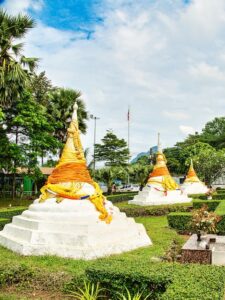 The Three Pagodas Pass is often described as a “temporary” or “semi-official” crossing, and the ambiguity is not merely bureaucratic. Thailand and Myanmar have never fully agreed on the demarcation of this section of their shared boundary. The dispute is not academic: in 2016, Myanmar’s government blocked a Thai proposal to upgrade the pass into a permanent trading post, citing unresolved territorial issues. Thailand had already constructed buildings and a highway in what Myanmar considers its own territory, and the impasse has persisted for decades.
For visitors, this means the crossing operates under a peculiar set of rules. Thai citizens can pass with an identity card. Foreigners, depending on the current arrangement, may be permitted to cross for a day visit to the market on the Myanmar side—Payathonzu, or Phaya Tong Su—but they cannot use the crossing for visa runs, and they must return before the checkpoint closes in the evening. The rules can shift; it is advisable to check with the Sangkhlaburi immigration office before planning a crossing.
What the Pass Offers the Traveller
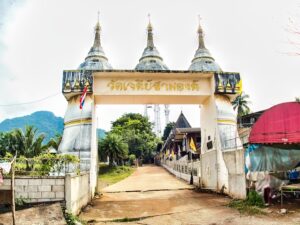 The Thai side of the pass is a small, functional settlement. A market sells Burmese goods—carved wood, textiles, jade, and foodstuffs—alongside Thai souvenirs. There is a replica of the three pagodas on the Thai side for those who do not cross; the originals, somewhat confusingly, are on the Myanmar side and not visible from the checkpoint. The atmosphere is unhurried, especially on weekdays, when the tour buses are absent and the border feels like what it is: a small crossing in a remote corner of a large country.
The drive itself is part of the experience. The road from Sangkhlaburi passes through Mon villages and alongside the vast, man-made Vajiralongkorn Lake, created by the Khao Laem Dam. The lake submerged an old Mon village, and the temple that once stood there can still be seen beneath the water in the dry season. It is a landscape of layered histories—ancient, colonial, and modern—compressed into a few hours of driving.
A Note on Expectations
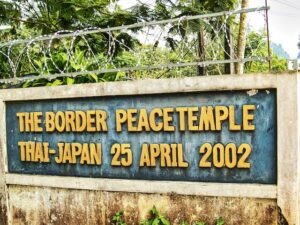 Three Pagodas Pass is not a destination that rewards a checklist mentality. There is no grand museum, no interpretive centre, no polished visitor experience. What it offers is something more intangible: the chance to stand at a point where two nations meet, where the fiction of a clean border is laid bare, and where the past is not confined to books but embedded in the ground beneath your feet. It is a place for travellers who find meaning in geography, in the stories that borders tell, and in the quiet corners of a country that rarely makes it onto the standard itinerary.
For those making the journey, the practical details matter. The checkpoint is open from 6:00 AM to 6:00 PM. Foreigners wishing to cross should bring passport photographs and expect to pay a fee—historically around USD 10—though policies can change. The road from Kanchanaburi is good but winding, and the journey takes the better part of a day. It is best combined with an overnight stay in Sangkhlaburi, where the Mon Bridge and the morning alms-giving at Wat Wang Wiwekaram offer a gentler introduction to this borderland. The Three Pagodas themselves are small. The history they represent is not.
Photos by Guglielmo Zanchi (Pluto)


